Lichens in the PNW

Here is a beautiful story by marvelous naturalist and science writer Lynda Mapes for your reading pleasure. I copied it from The Seattle Times ( I subscribe) so you can read it without the pop up window demands. Here is a link to Common Macrolichens in the PNW.
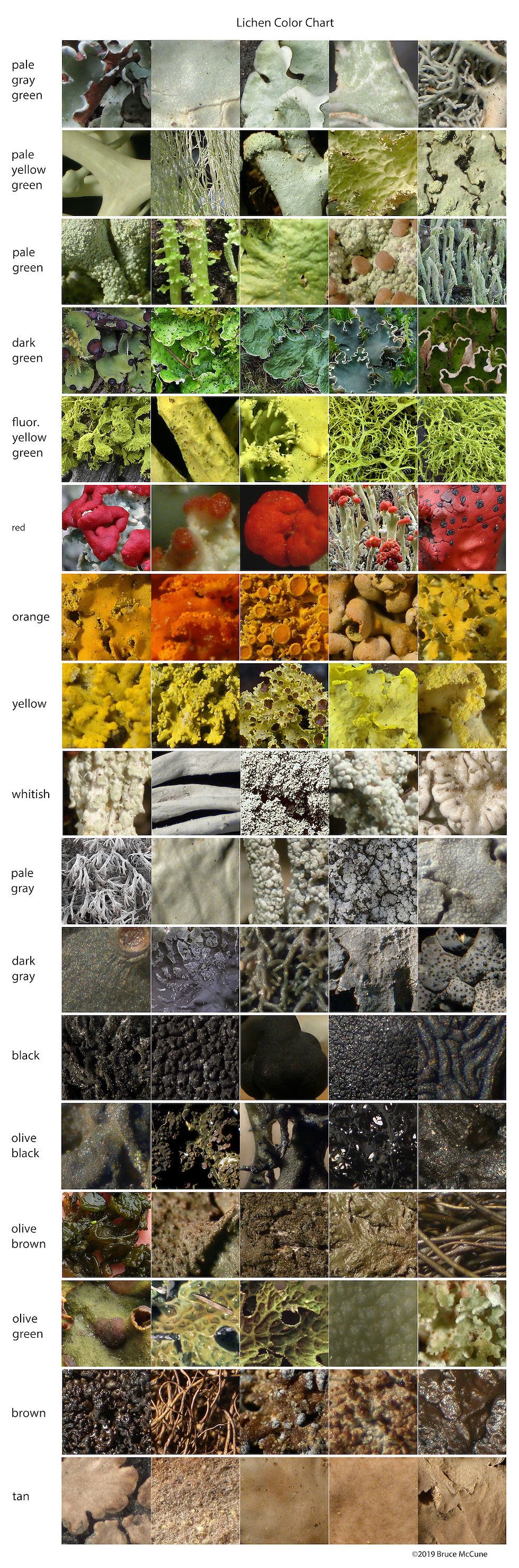
Color chart of PNW lichens for all you artist scientists out there:

‘See the whole world in lichens,’ the marvels that grow anywhere
June 27, 2026 at 6:00 am Updated June 27, 2026 at 6:00 am
By
Special to The Seattle Times
YOU MIGHT THINK that in the kingdom of green that is our Northwest, the mighty Douglas fir is supreme, or perhaps the red cedar. Ah, but consider the humble, the ancient, the ultimate in Northwest non-fussy, the enduring, inspiring signature of our regional character. That companion to Washington landscapes, whether east side or west, that thrives on just about any surface — dry, wet, bright, dark, hard, soft, natural, manufactured, whatever. Consider lichens.
They blow like green scarves from trees, crust rocks, frost fences, paint bark, and glow on roofs, tombstones, blue tarps — really anything that will stay still for a bit can be a swell home for a lichen.
Lichens delight, confound and inspire. A thing unto themselves on the tree of life, they have puzzled scientists for more than a century as to just what they even are. One of earth’s most adaptable forms of life, lichens live on every continent and have passed multiple tests of their ability to survive in outer space, even for months.
Beyond their persistence, lichens are productive: They bind and build soil. Work as bioindicators of air pollution and climate change. Produce nitrogen from thin air that feeds the forest floor and wildlife. Hummingbirds and bushtits gather lichens to wind into their nests. Ungulates, including caribou, elk and deer, subsist on lichens in winter, when other foods are scarce.
Lichens provide dyes, food and medicines for people, too, with their antimicrobial, antifungal and immune-support attributes deployed in traditional herbal medicines. Extracts of lichens also are used in deodorant, toothpaste, salves, extracts, teas and perfume.
Self-sufficient, lichens have no roots, no vascular tissue, make their own food and don’t need pollinators to reproduce.
They are green, black, orange, yellow, chartreuse, gray, white and even blue — and every shade in between. Shaped like leaves, like blowing beards, like pixie cups, like newly brushed paint.
And they are found just about everywhere in Washington, from the basalt rocks of the Columbia River plateau to the forests on both sides of the Cascades. Across the planet, they live everywhere from the polar deserts to grasslands, temperate and tropical forests, from polluted urban environments to old-growth forests — everywhere but the deep ocean.
Caption: Grey, orange and yellow crustose lichens grow in the Sun Lakes-Dry Falls State Park area in Eastern Washington. Lichens often grow very slowly, increasing less than a millimeter a year, says Katherine Glew, affiliate curator of the Lichen Collection at the Burke Museum Herbarium. (Erika Schultz / The Seattle Times)Grey, orange and yellow crustose lichens grow in the Sun Lakes-Dry Falls State Park area in Eastern Washington. Lichens often grow very slowly, increasing less than a millimeter a year, says Katherine... (Erika Schultz / The Seattle Times)
Quiet and immobile as they may seem, they are actually articulate storytellers. The presence — or absence — of a lichen species, and changes in either, can indicate a shift in air quality and narrate the march of climate change.
And for all their fixedness — lichens are remarkably slow-growing — they are not passive. Some lichens wage mighty battles to define their boundaries, deploying chemical warfare, visible in a black line around their borders, to keep other lichens or their mortal enemy, moss, from encroaching, and even growing right on top of them, snuffing them out.
Invitation to a special world
Katherine Glew, affiliate curator of the lichen collection at the Burke Museum Herbarium, has been fascinated with lichens for 53 of her 74 years. She delights in leading lichen walks, for everyone from lichen first-timers to superfans.
On a recent late winter day walk at the Washington Park Arboretum, the trees were still bare of leaves, revealing them to be richly cloaked with wet and plumping lichens growing on branches, twigs and trunks.
Cameras and hand lenses at the ready, these lichen enthusiasts peered at everything so slowly it took more than a half hour for them to even get out of the parking lot. One participant’s car got a close inspection; lichens were thriving on its paint.
Katherine Glew, second from right, leads a lichen walk at Washington Park Arboretum. She’s the affiliate curator of the lichen collection at the Burke Museum Herbarium on the University of Washington campus. (Erika Schultz / The Seattle Times)Caption: A walk participant, left, examines a ruffle lichen (Parmotrema). The lichen, moss and algae growing on a car, right, also catch the attention of the group. (Erika Schultz / The Seattle Times)A walk participant, left, examines a ruffle lichen (Parmotrema). The lichen, moss and algae growing on a car, right, also catch the attention of the group. (Erika Schultz / The Seattle Times)
“I like giving these walks, it’s so rewarding,” Glew says, “People say, I never noticed lichens before, now I see them everywhere.”
Lichens are an invitation to appreciate the diversity of life, she says. “People think only of cats or dogs, or maybe if they are in a place like Port Orchard, maybe sheep or goats, corn or apple trees … That is so narrow.”
Lichens reveal just how marvelous our niche here in the Pacific Northwest truly is — where even a parked car can be a platform for biodiversity. Appreciating the lichenhood of our day-to-day lives can be a source of wonder and joy. There are, Glew noted, at least 1,000 known species of lichens in the region. With their cool, moist climates, the Pacific Northwest and south coast of Alaska are home to some of the richest varieties of lichens — and with such marvelous names! Specklebelly, pixie cup, goat’s beard, witch’s hair, golden dust, egg yolk, oakmoss, tree flute, belly button, frog pelt.
Lichen Nation. That’s us.
It’s not what most people think
Lichens are, it turns out, even more wondrous than scientists knew. They are not mosses. They are not any other kind of plant or even an individual organism.
Indeed, lichens inspired a German botanist in 1877 to coin the word symbiosis in biology, to describe more than one species living together in long-term close association.
As first understood, lichens are the result of an alliance between an alga that makes the food through photosynthesis and a fungus, which provides the physical structure that gives the lichen its shape and anchors it to a surface, such as a rock or tree.
The idea that such a relationship could be neutral — or parasitical but also beneficial — was radical, following the 1859 publication of Charles Darwin’s “The Origin of Species,” in which he centered natural selection through competition as the primary driver of evolution.
In lichens, though, was something else altogether: an arrangement that is mutually advantageous.
Staghorn lichen (Evernia prunastri) grows at Washington Park Arboretum. (Erika Schultz / The Seattle Times)Crustose lichen grow in the high-desert shrubsteppe ecosystem near Vantage, Kittitas County. (Erika Schultz / The Seattle Times)Cladonia bellidiflora, also called toy soldiers, is a fruticose, a cup lichen species with red disks. Photographed at the Burke’s Herbarium. (Erika Schultz / The Seattle Times)The lichen Usnea longissima is particularly sensitive to pollution. Its presence indicates good air quality. (Erika Schultz / The Seattle Times)
Such symbiosis was a blockbuster concept in the late 19th century; nature not only was “red of tooth and claw,” as Darwin taught. Instead, lichens point to many interactions in nature in which entities persist by giving something to one another.
Many plants for instance are fertilized by pollinators, which in turn get their food from pollen. Trees, and other vascular plants, benefit from the nutrient exchange enabled by mycorrhizal fungi that thread through their roots and the soil, vastly increasing the area from which the plant attains moisture and minerals; meanwhile the trees feed the fungi with the sugars photosynthesized by their leaves.
Now scientists are learning lichens are even more complex than was previously known, made up of not just two entities but more — making each lichen its own mini-ecosystem.
Crucial living and stored archives
Deep in the dark warrens of Hitchcock Hall on the University of Washington campus, a world of wonders awaits in the Burke’s herbarium, a collection of more than 700,000 specimens of plants, fungi, lichens and algae, for use by researchers as well as the general public.
Here, the lichen collection is Glew’s special redoubt. Thousands upon thousands of specimens lie in repose in the dark silence of drawers and cabinets, each folded decorously in a white paper packet with careful notes on its name, origin and date of collection.
Katherine Glew, the affiliate curator of the lichen collection in UW’s Hitchcock Hall, says lichens help people better appreciate the diversity of life on our planet. (Erika Schultz / The Seattle Times)Lungwort (Lobaria pulmonaria) grows on a stump along the Middle Fork Snoqualmie River. Lobaria is a valuable winter food for wildlife, including deer and elk. (Erika Schultz / The Seattle Times)Sphaerophorus thrives on a stump along the Oxbow Loop Trail by the Middle Fork Snoqualmie River. (Erika Schultz / The Seattle Times)Glew creates labels for lichens that will be placed in the Herbarium’s collection. She has been collecting lichen samples since 1981. (Erika Schultz / The Seattle Times)
Glew slides a box from a cabinet and pulls an envelope from the trove. Unfolding it, she takes a perfect gray-green shred of lichen — collected from the Elwha River valley — and positions it under a microscope lens, lights ablaze, the better to show its intricate structure.
Lichens curated in research collections such as the Burke’s provide crucial long-term records by which to investigate environmental change.
Lichens are living archives. Changes in their presence, absence or health reflect local climate history, air quality and even cataclysmic events, both natural and human-caused. In their quiet testimony, lichens tell us things we need to hear about our changing world.
Lichens from the Elwha River valley on the Olympic Peninsula narrate ecological change before and after dam removal on the Elwha, which was completed in 2014. Other samples of lichens collected from the Spirit Lake area at Mount St. Helens bracket the volcano’s 1980 eruption.
Consider old-growth specklebelly lichen, an articulate witness as to the health of old-growth forests — and a charismatic species of lichen if ever there was.
In the wild, their robin’s egg blue, curled, leaflike forms cascade down the trunks of old-growth trees like a waterfall, their undersides pale and, yes, speckled. A survey funded by the Washington Native Plant Society and reported by lead researcher Stephen Sharrett in the spring 2026 issue of the society’s journal Douglasia found Pseudocyphellaria rainierensis to be in 9% decline, in revisits to sites in Washington where they had previously been recorded. Old-growth specklebelly lichen are associated with old-growth trees and cool, moist habitats, and the decline in their population was found even in wilderness areas and national parks, in forests under stress from fire and climate change.
Lichens are articulate narrators of environmental change. Long-term monitoring of lichen populations in a place can document shifts in air quality, effects of climate warming, and landscape changes. The collection at the Burke herbarium in Hitchcock Hall... (Erika Schultz / The Seattle Times) Lichens have an otherworldly beauty and scientists are still puzzling out just exactly what they are. Original understood to be a partnership of a fungus and an alga, reality is turning out to be far more... (Erika Schultz / The Seattle Times)
Specklebelly is speaking to the loss of suitable habitat for old-growth trees, even in protected areas.
But then, lichens have a way of blowing things open. Just ask Toby Spribille.
“We underestimated lichens”
It was Spribille who revealed that lichens are not a twosome at all, but actually a ménage à trois, with a hitherto overlooked partner — for some 140 years.
Spribille and his collaborators shared their discovery in a 2016 scientific paper published in Science. Their genetic analysis found that lichens aren’t just the result of a single fungus and a photosynthesizing partner (be it an alga, a cyanobacteria, or both.) They found there also is a second fungus, a yeast, in the mix. Follow-up DNA analysis by Spribille and his colleagues — of 52 lichen genera from six continents — also detected the second fungus. The initial breakout from the one-lichen-one fungus paradigm was not a one-off.
Scientists are still exploring whether the yeast is truly a symbiotic contributor, or just along for the ride. But even discovering its presence was a shocker, revealing lichens to be ecosystems unto themselves, with complexities that scientists are still trying to understand.
“We underestimated lichens for a very long time,” Spribille tells me. “It is not so much that people in the past got it wrong, as that they were missing a part of the picture, with the tools they had available to them, before the advent of genomics and modern molecular DNA sequencing.”
Researchers had looked through their microscopes, with basically the same technology since the 1860s, and saw the same thing: two organisms.
Not anymore.
Lichens can live just about anywhere that stays still long enough for them to establish. Growing on an arboretum bench are several lichens including old man’s beard (Usnea sp.), tube (hypogymnia) and staghorn (Evernia prunastri). (Erika Schultz / The Seattle Times)
“There are a lot of different sorts of mashups out there in lichen symbiosis,” Spribille says. “We are just beginning to scratch the surface,” Spribille says.
That’s the way it’s supposed to work in science, as the search for new knowledge upends everything we thought we knew. For Spribille, that sort of questing is second nature.
“I grew up in the woods, turning over rocks and logs.” He says he went through all the phases of nature nerds: whales (not convenient for a boy growing up in cetacean-free northern Minnesota), birds, plants. Then, in his teen years, by then living in northwestern Montana, he was smitten with the great swags of lichens growing in the forests. “I resolved one day to understand these lichens,” he says.
At 18, Spribille sent a hunk of lichen he collected to a professor for identification and heard back that he had discovered a species new to science. “That got me really excited,” he says. “I got farther and farther down the rabbit hole of lichens, I became interested in their management and conservation.”
He didn’t know it at the time, but he had found his calling — and his breakaway. “I was Christian home-schooled by my parents and they thought science was the devil … this was not the case of parents helping out with a linear scientific pathway,” Spribille explains.
His parents had stopped paying for education curriculum materials, Spribille says, by about age 13, but his dad left him alone for many long hours with a shortwave radio and headphones.
“I got a lot of my education from the BBC World Service,” Spribille says. “I would annoy my parents by talking in a British accent. That is how I engaged in the world as a nerdy, extremely lonely, isolated teen. But I am a curious person and an inquisitive person, and I have the chutzpah to ask too many questions.”
Yellow crustose lichen grows near Sun Lakes-Dry Falls State Park. (Erika Schultz / The Seattle Times)
Ultimately, he got a job at the local U.S. Forest Service station during the early years of the Clinton presidency, when there was a lot of money for studying the biodiversity of the forest. “They gave me the keys to a pickup, and a job to go out and collect,” Spribille says. The job paid him to collect rare plants in areas of planned logging, but he also kept an eye out on the sly for lichens. He was 19.
“My whole life has been enriched so much by lichen and the people it has helped me connect with.”
But then, lichens often lead people to view their entire world through another lens, he notes. The 2016 threesome reveal was a scientific sensation. “It clearly broke through the noise, it has given people permission to think differently,” Spribille says. And some take that much farther than others.
Gobsmacking science
For Trevor Goward, co-curator of lichen at the University of British Columbia Herbariaum at the Beaty Biodiversity Museum in Vancouver, understanding why lichens matter helps people remember the ways in which we are all connected. Not just the algae, the fungi and the yeasts, but all of us, needing one another.
“Why wouldn’t they matter?” Goward says of lichens. “There are animals that feed on them, reindeer and caribou would not exist without them, they are beautiful, they color our world, they grow where other things don’t grow, they can live where nothing else can, they have the capacity to grow everywhere.”
And they are that example in nature in which one plus one equals … three. Perhaps that is why lichens have challenged science for so long.
There are 1,500 to 2,000 described lichen species in the Pacific Northwest, more than 6,100 in North America and 25,000 to 50,000 worldwide, Glew says. Shown is Usnea longissima. (Erika Schultz / The Seattle Times)
“Science is reductionist,” Goward said. “The study of biology reduces life to its parts, the whole disappears. Lichens challenge that.”
To him, though, it goes much deeper. Lichens provide a window to see how in life things really work.
“It is still gobsmacking, the idea that lichens are a portal through which you look in one direction, and what you look at is the organism, and you turn around and what you see is the ecosystem, and they are a variation on the same thing.”
And of course, for that matter, so are we, existing both as individuals and as ecosystems, teeming with microbial life and pulsing with systems they largely control. Next time your gut isn’t happy, bow humbly to the microbes with which you share yourself.
This, our true nature, and our place in a connected web of creation, are worth pondering and reckoning with, as we enter what Goward calls not the Anthropocene — as that implies humans at the helm — but the Pandoracene. A time of consequences.
The way forward to a better future is an empathic relationship with the living world, Goward says, a future in which we recognize and honor our connections to the earth, and one another. Lichens, he continues, are our ancient mentors in this, reliable truth tellers about how the world really works.
“You can see the whole world in lichens.”
Lynda V. Mapes is a Seattle writer and a former reporter at The Seattle Times. Reach her at lyndavmapes.com. Erika Schultz is a Seattle Times staff photographer: eschultz@seattletimes.com.


Comments